
Your plan for next year says 200 jobs. You got that number by taking this year’s 170 and adding a good feeling about the spring. Then you handed it to the call center and told them to set more appointments.
There is nothing underneath that number. A plan that survives contact with February starts at the smallest piece of the business you actually control, which is one hour of one person on the phone, and builds up from there until it either reaches your goal or tells you the goal was made up.
Start at the phone hour
Take a window company selling ten-window packages at $12,000 with a 40 percent gross margin. Gross margin is what is left after the material and the crew that installed it, so each sale puts $4,800 of gross profit into the company.
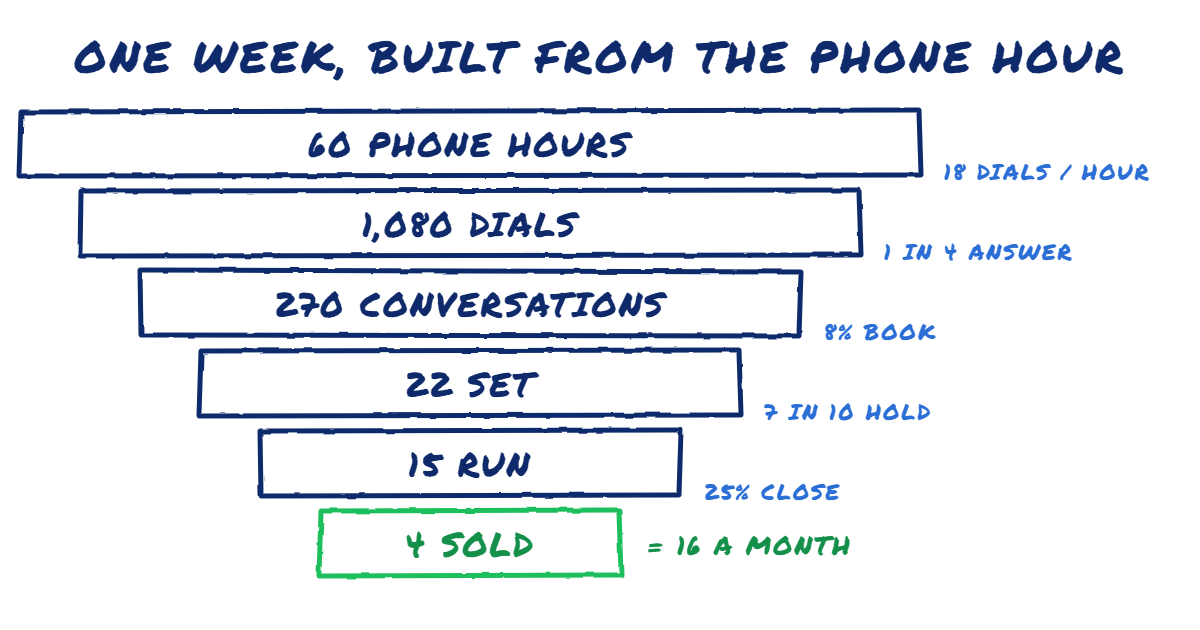
Two people on the phone, each spending 30 of their paid hours actually dialing, gives you 60 phone hours a week. At 18 dials an hour that is about 1,080 dials. Say one in four reaches a live homeowner, which is 270 real conversations. Eight percent of those conversations end with an appointment on the calendar, so 22 get set. Seven out of ten of those hold, so about 15 get run. Across a month that is 65 appointments run, and at a 25 percent close rate you sold 16 jobs.
Sixteen a month is 192 a year. Your plan said 200.
That gap is now a specific thing instead of a pep talk. Eight more jobs a year works out to about three more appointments run a month, which is four more set, which is eleven more conversations a week, which is roughly 45 more dials. Call it two and a half extra phone hours a week. Half a day of dialing covers the number you were planning to get by asking people to try harder.
The one number that runs the plan
Sixteen sales a month at $4,800 is $76,800 of gross profit, produced by about 260 phone hours. That is $295 of gross profit for every hour someone spent dialing.
Now price the hour. A call center rep at $22 an hour with payroll taxes in it, dialing 30 of 40 paid hours, costs you about $29 for every hour actually on the phone. Each dollar you spend on the phone comes back as roughly ten dollars of gross profit.
Watch that figure every week and you will know within days whether your plan is still real. When gross profit per dialing hour falls, the cause is always one of the six numbers above, and you can find it in an afternoon.
Where this plan breaks
Hold rate is the usual culprit. Let the share of set appointments that actually happen slip from seven in ten to six in ten and the same 22 sets a week produce 57 appointments run a month instead of 65. At the same close rate, that is 14 sales instead of 16. Two sales a month is $9,600 of gross profit, and $115,200 over a year, lost to homeowners who were not called the night before.
The other breakpoint is the list. Those 1,080 dials a week chew through 6,000 homeowners at three attempts apiece in about seventeen weeks. After that your team is calling the same people a fourth time and the contact rate collapses, which looks exactly like lazy callers on a report. A phone-hour plan without a list plan runs out of road in the middle of the selling season.
Argue about the assumptions before you argue about the total
Six numbers hold up everything above: dials per hour, contact rate, set rate, hold rate, close rate, and average job size. Every one of them is a guess until you pull last quarter’s actuals and look.
Do that argument out loud, with the person who runs your phones and the people who sit at kitchen tables, before anyone signs off on an annual number. Ask where 18 dials an hour came from. Ask whether a 25 percent close rate was true in November or only in May. Ask what happens to all of it if your best closer quits in March, and write down what you would do. Most owners skip this conversation in December and spend the next eleven months explaining a miss they could have seen coming.
Seasonality belongs in the same argument. The plan should not read 16 sales a month twelve times in a row when you know August is slow and your phone team takes vacation.
A plan in a drawer is a budget
A number set in January and never touched is a license to spend. The useful version gets updated against what actually happened.
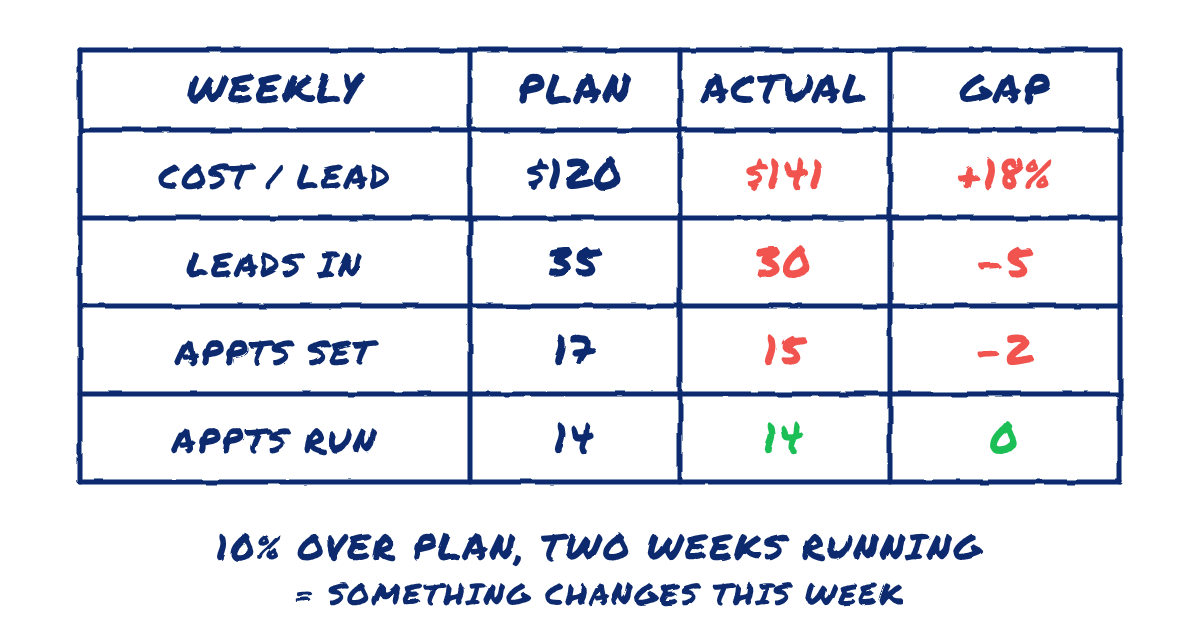
Every Monday, write last week’s dials, conversations, sets, and appointments run next to what the plan called for, then re-forecast the rest of the quarter using the real figures. Three weeks of 14 appointments run against a plan of 15 is not noise, it is four sales a year walking out the door, and you still have ten months to fix it. Find that out in October and all you can do is write a new plan with the same feeling behind it that the last one had.
Pull four weeks of call records and count four things: dialing hours, dials, appointments set, and appointments actually run. Then take the gross profit from the jobs those appointments produced and divide it by the dialing hours.
If that number comes in under $200 an hour, your problem sits upstream of your closers, and the fix is in the six assumptions rather than in another lead source.