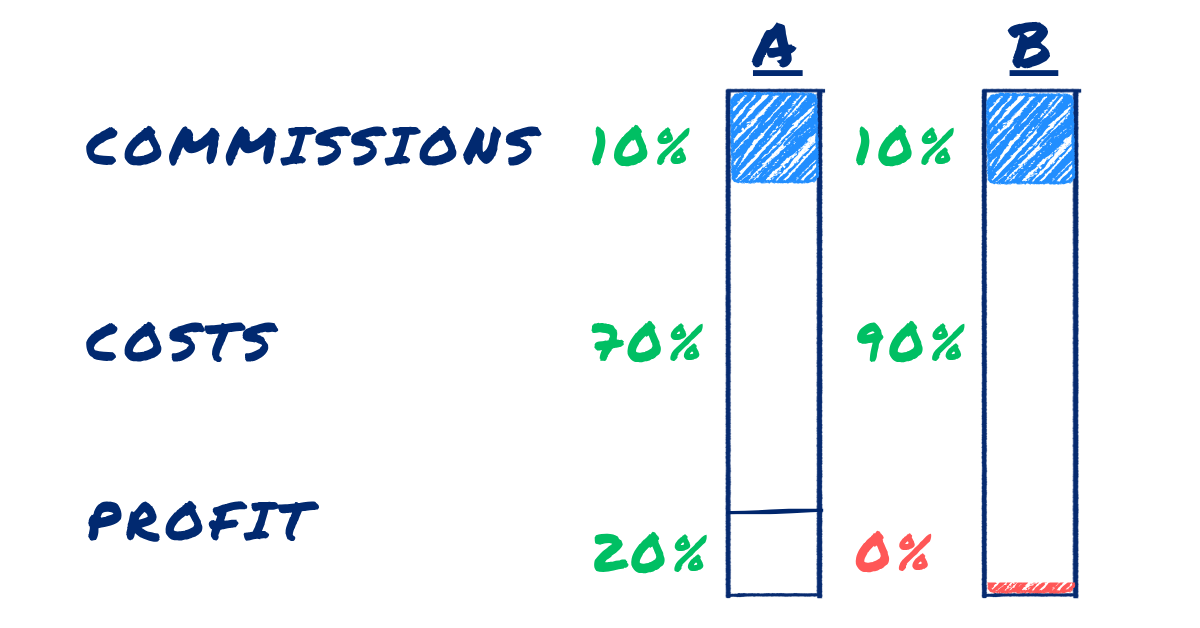


You pay your people 10 percent of what they sell. It feels fair. It feels simple. It feels like the kind of clean, round number a smart owner picks. And it is quietly bleeding your business dry.
Here is the hard truth nobody told you when you set that number. Paying commission on revenue is one of the most expensive mistakes a small business owner can make, and the worst part is you’ll never see it on a single invoice. There’s no line item that says “money I gave away for no reason.” It just disappears into every sale, month after month, while you wonder why a busy shop with a full schedule still leaves you scraping at the end of the month.
Let me show you exactly where the money goes.
The Number That Sounds Smart and Isn’t
Picture a remodeling company. Your estimator sells a bathroom job for $30,000. He earns 10 percent, so he takes home $3,000. Sounds reasonable. But look at what’s underneath that $30,000. The tile, the fixtures, the lumber, the subs you hired to do the plumbing and the electrical, all of it might run $18,000. So the real money the business made on that job, before anything else, was $12,000. Out of that $12,000, you just handed over $3,000. That’s not 10 percent of your money. That’s 25 percent of your money.
Now take a different job. Same estimator sells a $30,000 kitchen, but this one is loaded with expensive cabinets and stone the customer picked out, and the subs quoted high. The materials and subcontractors eat $27,000. You made $3,000 on it. The estimator still gets his $3,000, because he’s paid on the $30,000, not the $3,000. He kept every dollar the job earned. You kept nothing. You ran the crew, carried the insurance, warrantied the work, and walked away with zero, while he walked away thinking he had a great month.
This is the trap. When you pay on revenue, the commission stays the same whether the job was wildly profitable or barely worth loading the truck for. Your estimator has no reason to care which is which. He just wants the contract price to be big. So he sells the jobs that are easy to sell instead of the jobs that make money. He throws in the upgrade to close it. He shaves the price when the customer hesitates, because a discount costs him three hundred bucks and costs you three thousand. You are paying a bonus for the exact behavior that is killing your margin.
Why Selling More Makes It Worse
Most owners respond to a cash problem by trying to sell more. Push the estimators. Run an ad. Book the crews out three months. And the trap closes tighter, because commission on revenue grows with every job you sign. The harder your people sell, the more of your thin profit you give away. You end up with a full backlog, record revenue, exhausted crews, and a bank balance that doesn’t match the story you’re telling yourself.
There’s a CPA named Greg Crabtree who spends his life looking under the hood of small businesses, and he’s blunt about this. He says owners pick numbers like “10 percent of revenue” out of thin air without ever running the math on what they’re actually giving away. They never sit down and figure out that every dime of extra sales might be flowing straight to an employee who didn’t even cause the growth. You took the risk. You signed the lease. You’re the one who lies awake. And you set up a deal where the more the business sells, the less of it you keep.
The Fix Is Simpler Than the Trap
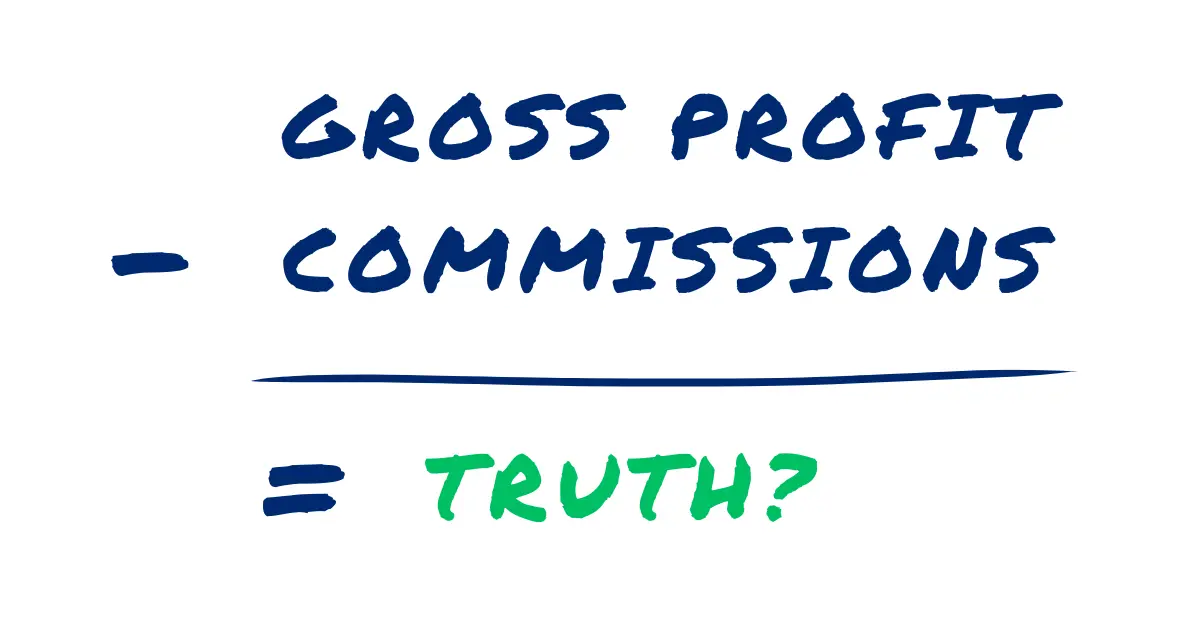
You don’t need to gut your pay plan or pick a fight with your best closer. You need to move the commission off the contract price and onto the profit. Pay your people a cut of what’s left after materials and subs, not a cut of the headline number on the proposal.
The moment you do that, everything changes. Now your estimator has a reason to sell the job that makes money instead of the job that’s easy to sell. Now a discount costs him too, so he stops giving away your margin to avoid an awkward conversation. Now he bids the subs harder, because sloppy numbers come out of his check as well as yours. His interests and your interests finally point the same direction, which is the only place a pay plan should ever point them. And a good plan is simple enough that the man earning it can run the math in his head on the drive home. If your people can’t calculate their own pay, the plan won’t change anyone’s behavior.
Stop paying people to be busy. Start paying them to be profitable. The 10 percent number isn’t fair and it isn’t simple. It’s a leak, and you’ve been bailing instead of plugging it. Fix the formula, and watch how fast you change from a busy contractor to a profitable one.