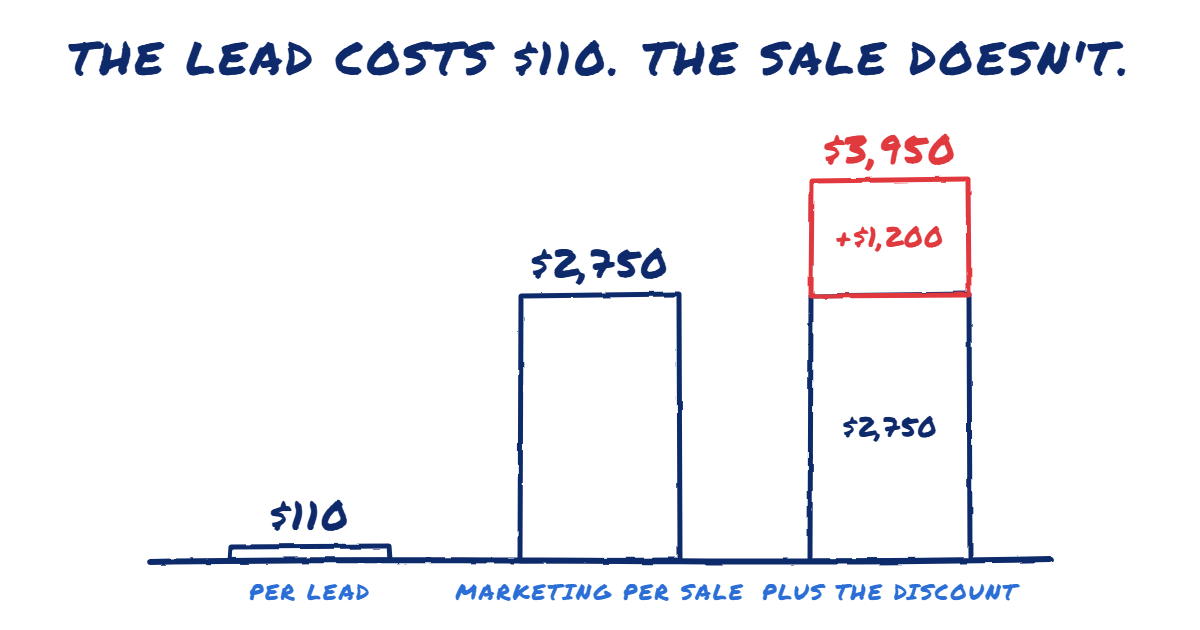

The lead costs $110. That is the number you repeat to yourself every time the invoice comes through, and it is the only number in this whole arrangement that is working the way you think it is.
By the time one of those leads turns into a job on the production schedule, it cost you $2,750. Then you gave away $1,200 more at the kitchen table to beat the two other contractors who bought the same homeowner.
Run the same money through two channels
Take a bath remodeler selling tub-to-shower conversions at an average of $15,000 with a 40 percent gross margin. Gross margin is what is left after the acrylic and the installer, so a clean sale puts $6,000 of gross profit into the company. The budget is $11,000 a month either way.
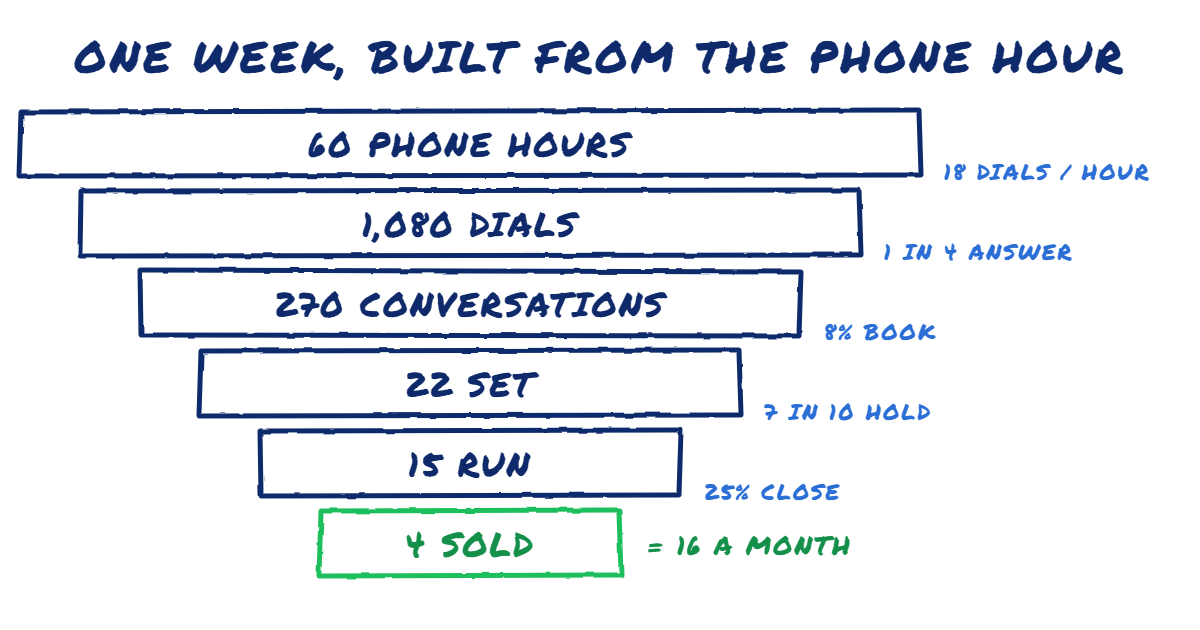
Spend it with an aggregator and you buy 100 shared leads at $110. Your office reaches enough of them to set 45 appointments, about 31 of those actually hold, and your closer sells 16 percent of what he sits in front of. That is five jobs. Divide $11,000 by five and each sale cost you $2,200 in marketing before anybody picks up a tool.
Now finish the month. Four of those five sales came with a discount because the homeowner had two competing quotes on the counter, so gross profit per job is $4,800 instead of $6,000.
One of the five cancels inside the three-day window, which is normal on a lead that was shopping rather than buying. You are down to four jobs, your real cost per sale is $2,750, and the month produced $19,200 of gross profit against $11,000 of spend. You kept $8,200 for 31 evenings of selling.
Spend the same $11,000 on leads you generate yourself at $275 apiece, and you buy 40 of them. Past customers, referrals, direct mail into neighborhoods where you already have a job sign, canvassing around an install in progress.
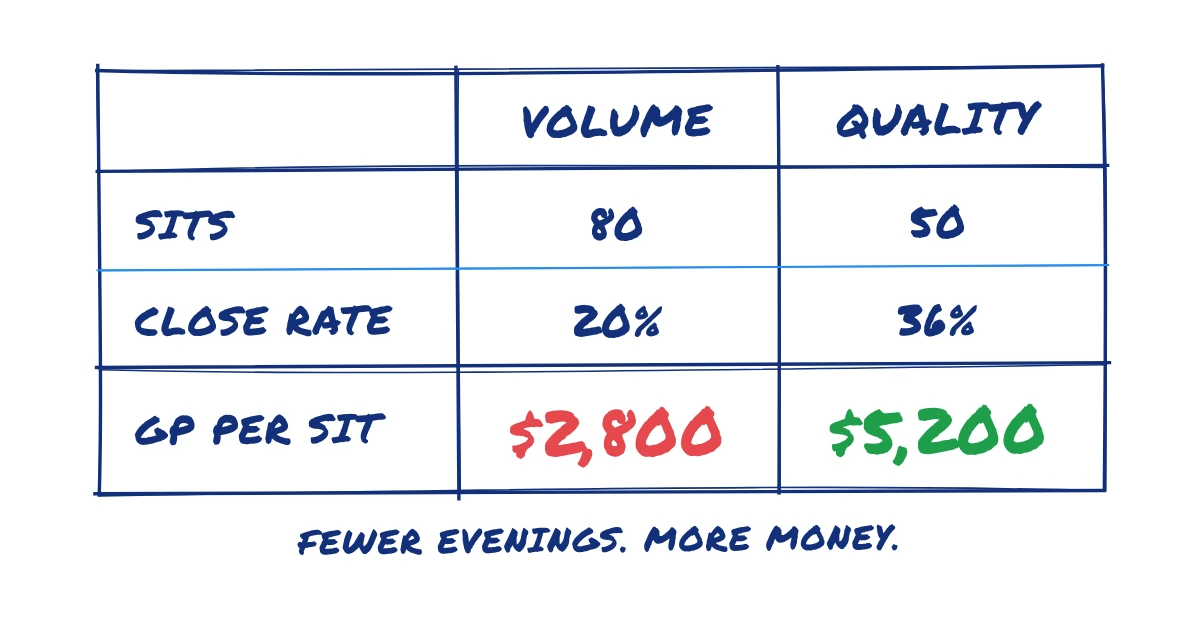
These people called you by name, so you set 28 appointments, 24 hold, and your closer sells 30 percent. That is seven jobs at $1,571 of marketing cost each, no discount war, and $42,000 of gross profit. After the $11,000, you kept $31,000 for 24 evenings of selling.
Same money. Three fewer sales, seven more evenings burned, and $22,800 less gross profit in the aggregator month. Run that split all year and the gap is $273,600.
Why the close rate is the number that collapses
Nothing about the homeowner changed between those two months. What changed is where they were in their own thinking when your name reached them.
A past customer who calls you already knows who you are and mostly wants a date on the calendar. A homeowner who fills out a form on an aggregator site knows one thing, which is that several contractors are about to call and he is supposed to compare them.
He was handed the comparison before he ever heard your pitch. Your salesperson walks into a conversation that started as a price contest, and the only move left in a price contest is to cut the price.
That is why the close rate drops from 30 percent to 16 and why the jobs you do win come with $1,200 shaved off. Both of those are the same problem wearing different clothes.
What happens when you double the budget
Here is where the volume thinking usually takes over. Five sales is not enough, so next month the budget goes to $22,000 and 200 leads.
Everything doubles. Ten sales, eight after cancellations, $38,400 of gross profit against $22,000 of spend. You kept $16,400 instead of $8,200. You added $11,000 of marketing and $60,000 of revenue to pick up $8,200.
Meanwhile your crews are installing twice the jobs, your office is handling twice the paperwork, and your salespeople are running 63 appointments instead of 31.
When revenue grows faster than earnings, every extra dollar of sales is doing less work than the dollar before it. The shop looks twice as busy on the way to the same bank balance, and most owners read that as a production problem and hire somebody.
There is a right way to buy a lead
Aggregator leads turn on in an afternoon, which is worth something when your calendar has a hole in it next week and your own sources take sixty days to produce. Use them for that, with a cap you set in advance, and judge them on cost per sale instead of cost per lead.
Then build the thing that makes them unnecessary. Write down who your best customer actually is, by neighborhood, house age, and job type, and build a list of those homeowners you own rather than rent.
Decide on three things you do that the two contractors quoting against you cannot claim, and make sure your office says them on the first call. Both of those take a quarter to pay off, and neither one gets cheaper by waiting.
Pull the real number tonight
Take every aggregator lead you bought in the last ninety days. Count the jobs that survived the rescission window and divide your total spend by that number. Then add up every dollar you discounted on those jobs and subtract it from the gross profit they produced.
If the answer is under half what your own leads return, stop the renewal before it bills again and move that money into the list you should have built two years ago.