
You spent $19,500 on leads last month and your team ran 45 appointments. In March, that same money bought you 60. You blamed the lead company and told yourself the market was soft.
The lead company had a hand in it. The bigger problem is that you built a sales calendar with only one way to fill itself.
Every inbound appointment runs through a chain that wobbles
Every appointment on your board is the last link in a chain. A homeowner sees your ad, clicks it, and fills out the form. Then she answers when your office calls back, agrees to a time when both homeowners can be home, and actually keeps it.
That is six steps, and none of them holds still. Your cost per click climbs in spring. Call-back speed slips the week your office manager is out. Confirmations fall apart around the holidays and on the first nice Saturday in May.
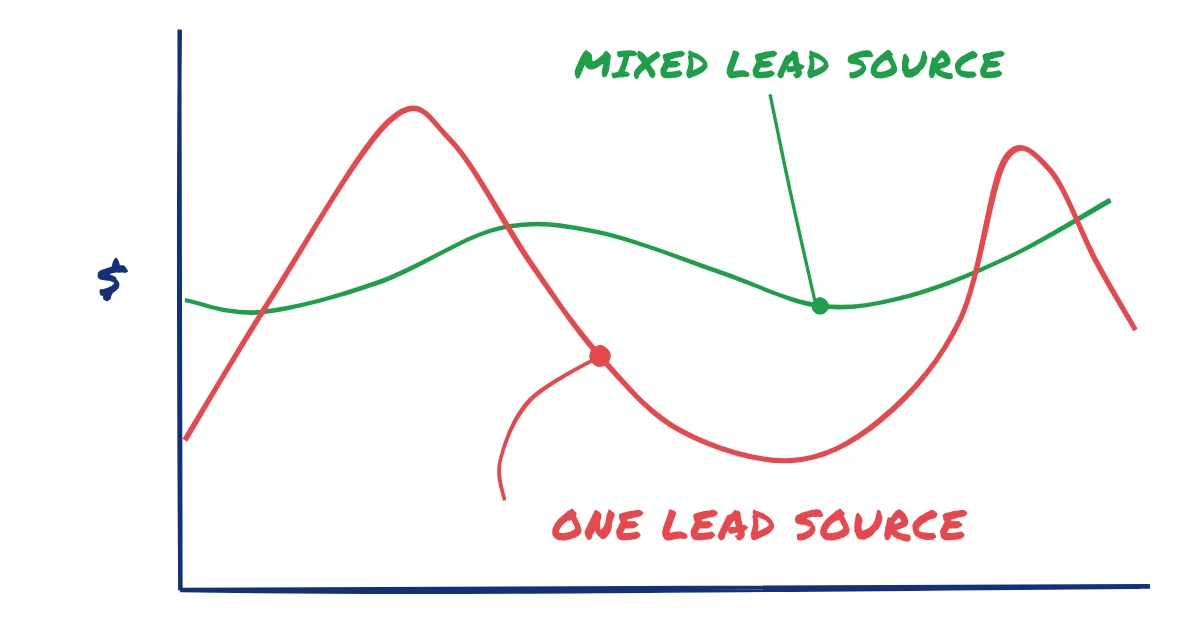
When all 60 appointments come through that one chain, every wobble lands on your whole month. Add two more lead sources that move for different reasons, and a bad week in one rarely lines up with a bad week in the others. That is the whole case for an appointment mix.
The three lead sources that fill a contractor’s calendar
An appointment mix is how your sales appointments split across the three ways a homeowner ends up at the kitchen table.
Inbound leads come to you. Paid search, your website, the home show booth, and the yard sign all count. Inbound turns on fastest and costs the most, because every other shop in the county is bidding for the same homeowner.
With outbound, you go to the homeowner. That means canvassing the street around a job in progress, calling a neighborhood after a storm, or mailing every house built in 1998 that still has its original windows. It is slower to build, but you control it, because you decide how many hours go into it this week.
Rehash leads are people who already sat with you. Think of the homeowner who got a price in April and did nothing, or the customer whose roof you replaced three years ago who never bought gutters. Working that list costs almost nothing beyond office time.
Run the numbers on a mixed month
Say you run a window company selling five-window packages at an average of $12,000. Your gross margin, the money left after you pay for material and the labor to install it, is 50 percent. That is $6,000 of gross profit on every sale. Your sales team can run 60 appointments a month.
Filling all 60 from inbound at $325 an appointment costs $19,500. Now build the same 60 another way. Thirty come from inbound at $325, which is $9,750. Eighteen come from canvassing at $120 each once you count the canvasser’s pay and the truck, which is $2,160. Twelve come from rehash at $45 each, mostly office hours spent working the list, which is $540.
That is 60 appointments for $12,450, or about $207 each against $325. The gap is $7,050 a month and $84,600 a year. If each source closes at the same rate, you sell the same number of jobs to get it.
Now break the month on purpose
The savings are the smaller half of this. Go back to the month inbound came in a quarter light.
With the all-inbound calendar, $19,500 bought 45 appointments instead of 60. Your real cost per appointment jumped to $433, and you were 15 short. At a 30 percent close rate, meaning three sales for every ten homeowners you sit with, that is four or five lost sales and about $21,600 of gross profit that never happened.
Your installers had a light week. Your overhead, the rent, trucks, insurance, and office payroll you pay whether you sell or not, stayed right where it was. The salesperson you spent a year training started looking around.
With the mixed calendar, the same inbound dip costs you about eight appointments. You cover them by buying extra canvasser hours and having the office call the unsold homeowners from four months ago. Both can be turned up on a Monday. The month lands within a few appointments of plan instead of 25 percent under it.
A workable starting target for most replacement contractors is half inbound, 30 percent outbound, and 20 percent rehash. The exact split matters less than the rule behind it. No single lead source gets more than half your calendar, because the day it moves, your year moves with it.
How to track appointments by lead source every week
Most owners track appointments set as one lump number. That hides the problem until payroll week. Break it out by source every Monday, against a weekly target for each.
At 15 appointments a week, that is seven or eight inbound, four or five from canvassing, and three from rehash. If Monday shows only two from rehash, you have four days to fix it. If you find out on the thirtieth, the month is already gone.
Rehash also refills itself if you let it. Every homeowner your team does not sell this month is a possible rehash appointment in ninety days, so even a weak close rate today buys you cheap appointments next quarter. Almost nobody works that list, and it is sitting in your CRM, the software where you keep customer records, right now.
Start this week
Pull the last three months and sort every appointment your team ran by lead source. Divide what you spent on each source by the appointments it produced, to see what each one really cost. If any source holds more than half the total, pick the cheaper of the other two and give it a weekly target starting Monday. Hold that target for ninety days before you judge it.